


About MOORE
Roxas Tabamo & Co.
Company Background
Company Background
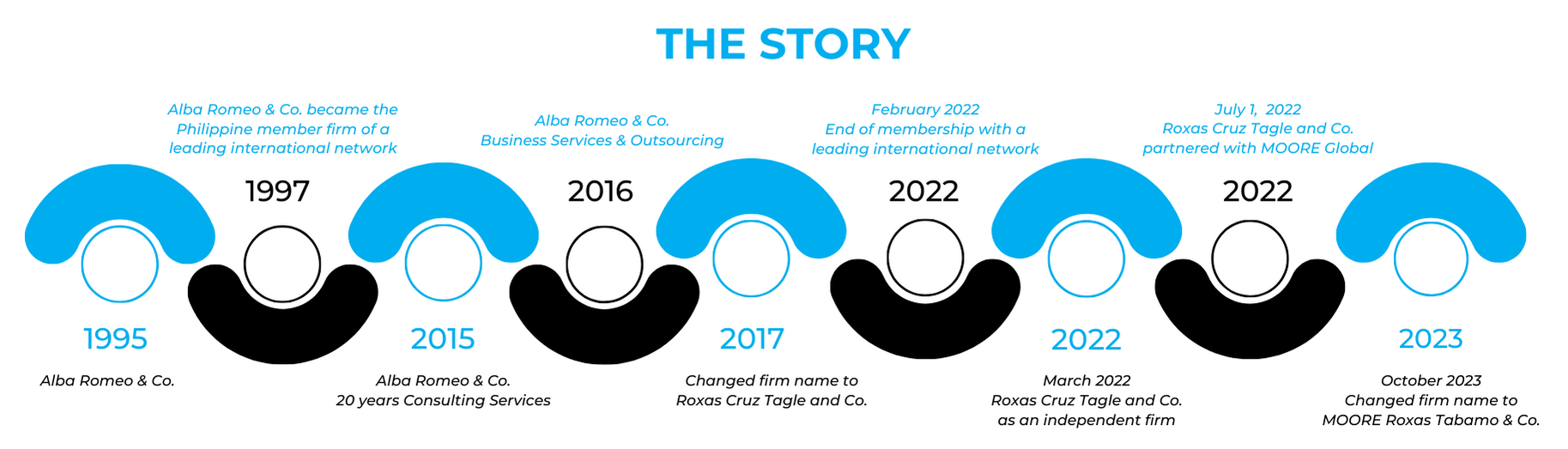
Established in 1995, Roxas Tabamo & Co. offers a complete range of professional services to domestic and international organizations across a range of industries.
Led by 17 partners and supported by a team of over 300 professionals.
We take pride in our service portfolio, which is supported by a potent combination of professional experience and expertise guided by methods and tools from our global network.
Mission & Vision

Mission
We, Roxas Tabamo & Co., are a transformative professional services provider of consistent personalized client service which truly stands out to domestic and multinational clients. We offer innovative and relevant ideas, solutions, insights, and business advice that clients can trust. Our in-depth knowledge of national regulations combined with an understanding of our clients’ local business needs allow us to offer our clients commercially astute and honest opinions.
We inspire our people and provide them with the best in training, opportunity, and reward – as we create an environment that promotes continuous learning, and assuring common corporate values and principles are in place to become an employer of choice in professional services. We trust our people that they live by the highest business ethics, and to use their skills and experience in delivering personalized client service.
Lastly, we involve our people and encourage our clients to participate in various corporate responsibility projects, which also implies volunteer support towards nation-building.
Vision
To be the most respected professional services firm in the country.
People and Purpose
People and Purpose
People
We take pride in our service portfolio, backed with a rich blend of experience and expertise from our professionals and guided by methodologies and tools from our international network. Our professionals partake in training that equips them with the competence and experience to better serve our clients, thereby bringing to force a work culture that is both client-centric and knowledge-driven.
Purpose
We are transformative professionals committed to nurturing responsible and sustainable relationships.

Our Values
Our Values
Different Kinds of Values
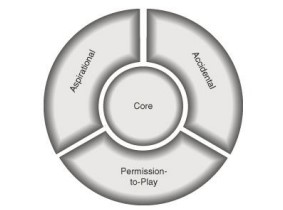
An important key to identifying the right, small set of behavioral values is understanding that there are different kinds of values. Among these, core values are by far the most important and must not be confused with the others. Let’s define the different types now so we don’t get them confused:
1. Grit
2. Resiliency
An organization knows that it has identified its core values correctly when it will allow itself to be punished for living those values and when it accepts the fact that employees will sometimes take those values too far. Core values are not a matter of convenience. They cannot be extracted from an organization any more than a human being’s conscience can be extracted from his or her person. As a result, they should be used to guide every aspect of an organization, from hiring and firing to strategy and performance management.
1. Integrity
2. Accountability
3. Adaptability
4. Compassion
5. Empathy
6. Agility
7. Receptive
8. Teamwork
9. Innovation
These values are the minimum behavioral standards that are required in an organization. Although they are extremely important, permission-to-play values don’t serve to clearly define or differentiate an organization from others. Values that commonly fit into this category include honesty, integrity, and respect for others. If those sound generic, something you’ve seen on virtually all of the values statements plastered on the walls of every mediocre company you’ve ever visited, then you understand the problem. Permission-to-play values must be delineated from the core to avoid dilution and genericism (I don’t think that’s a word, but you get the point).
1. Competitiveness
2. Discipline
3. Consistency
Confusing core and aspirational values is a frequent mistake that companies make. It is critical that leaders understand the difference.
1. Compromising
2. Passivity
3. Sense of Entitlement
These values are the traits that are evident in an organization but have come about unintentionally and don’t necessarily serve the good of the organization. In many companies, behavioral tendencies develop over time because of history, or because people start to hire employees who come from similar backgrounds. One day everyone looks around and realizes that just about every employee who works in the organization shares some quality: socioeconomic status, introversion, or good looks. The question that needs to be asked is whether being middle class, introverted, or good looking is something that the company has cultivated for a purpose, or whether it came about accidentally. It’s important that leaders guard against accidental values taking root because they can prevent new ideas and people from flourishing in an organization. Sometimes they even sabotage its success by shutting out new perspectives and even potential customers.
Our Partners
All People

















REPORT WITH CONFIDENCE
The Firm respects and protects the choices of the eligible person when making disclosures. You may remain anonymous if you wish. You may also want to provide all of your contact details to us or alternatively, you can provide all of your contact information to a Whistleblowing committee but not allow us to provide that information to the committee. The eligible person may choose to:
We are committed in ensuring that eligible persons who report disclosures covered by the Firm’s Whistleblowing Policy are fairly treated. The Firm respects and protects the choices of the eligible person when making disclosures.